.svg)
.svg)
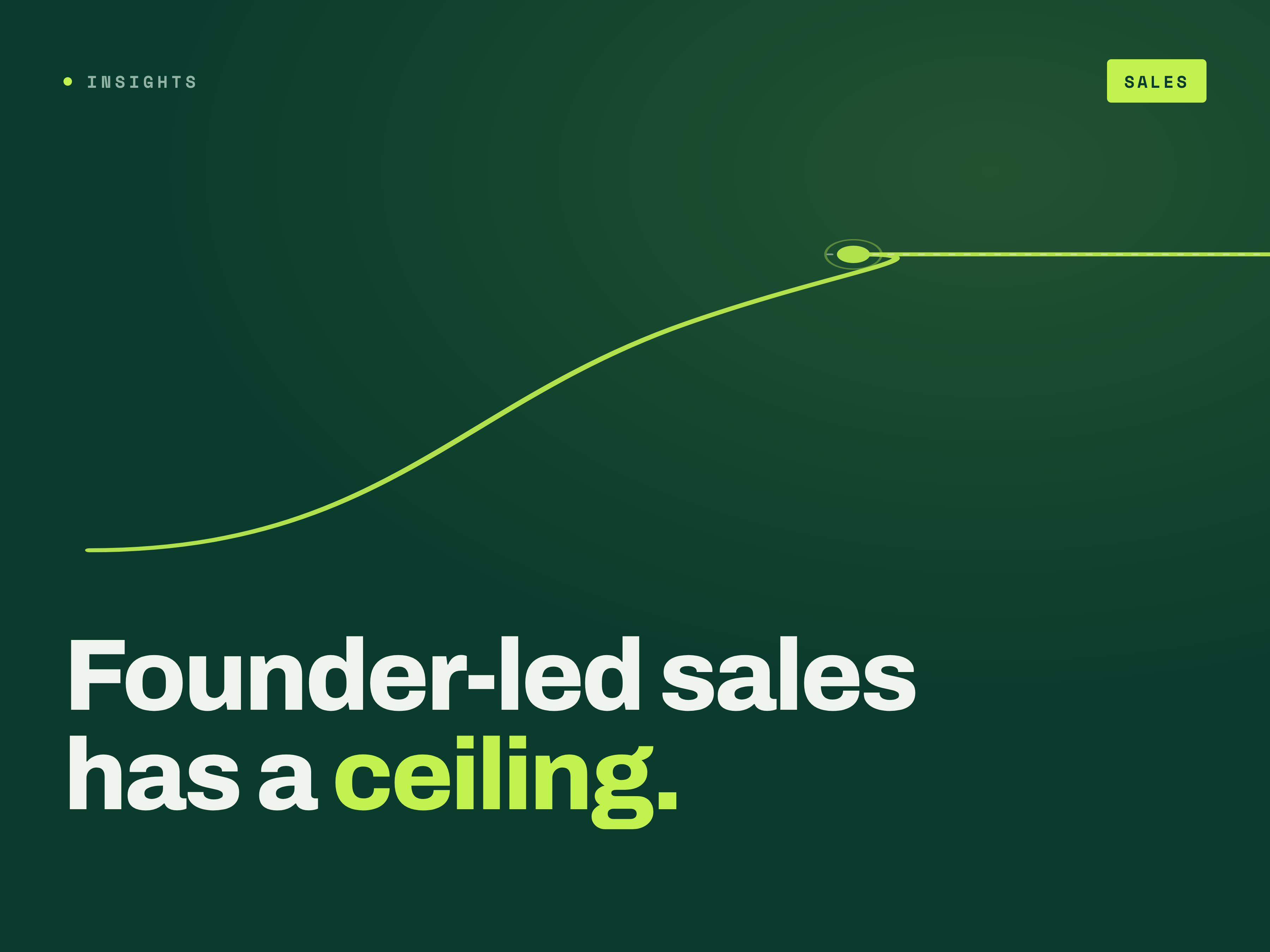
Founder-led sales has a ceiling. And it's not the one you think.
Most founders assume the ceiling is the market. Or the product. Or the budget.
It's none of those. The ceiling is your calendar.
Every deal runs through you. Every demo, every follow-up, every "let me check with my co-founder and get back to you." The pipeline moves exactly as fast as one person can move, and that person also has to build, hire, raise, and occasionally sleep. For a while that's a superpower. Then it's the thing holding the whole company back.
Here's what nobody tells you: founder-led sales doesn't break loudly. It breaks quietly. Growth flattens, but you blame the market. Deals slip, but you blame the quarter. You're working 60-hour weeks and still missing the number, and the honest explanation is the one nobody wants to say out loud. You are the bottleneck.
Where the ceiling actually sits
The numbers are surprisingly consistent. Founder-led sales tends to max out somewhere around 1 to 2 million in ARR. Some teams stall earlier, some push a little past it, but that's the band where the calendar runs out.
The warning signs are always the same:
→ Growth that was compounding now feels like pushing.
→ Close rates you can't really explain ("some months click, some don't").
→ A pipeline you forecast on gut feel, not on evidence.
→ Your best deals still need you personally in the room.
None of that means your sales are bad. It means your sales are you. And you don't scale.
Why hiring a rep usually doesn't fix it
So founders do the obvious thing. They hire a salesperson. Often a senior one, sometimes a VP with a logo on the CV, and they hand over the calendar with relief.
Then it doesn't work. The new hire doesn't close like the founder did. Six months later everyone quietly agrees it was a bad hire.
It usually wasn't a bad hire. It was a bad handover.
Because here's the thing you actually built in those first years: not a sales team, a sales instinct. You know which leads are real in the first two minutes. You know which objection means "convince me" and which means "no". You know why people buy, because you've watched a hundred of them do it. None of that is written down. So when you hand someone a calendar without the instinct behind it, you're not delegating a system. You're asking them to rebuild your intuition from scratch, alone, on a quota.
That's not a Growth Engine. That's a more expensive bottleneck.
What replaces it: a Growth Engine, not a hero
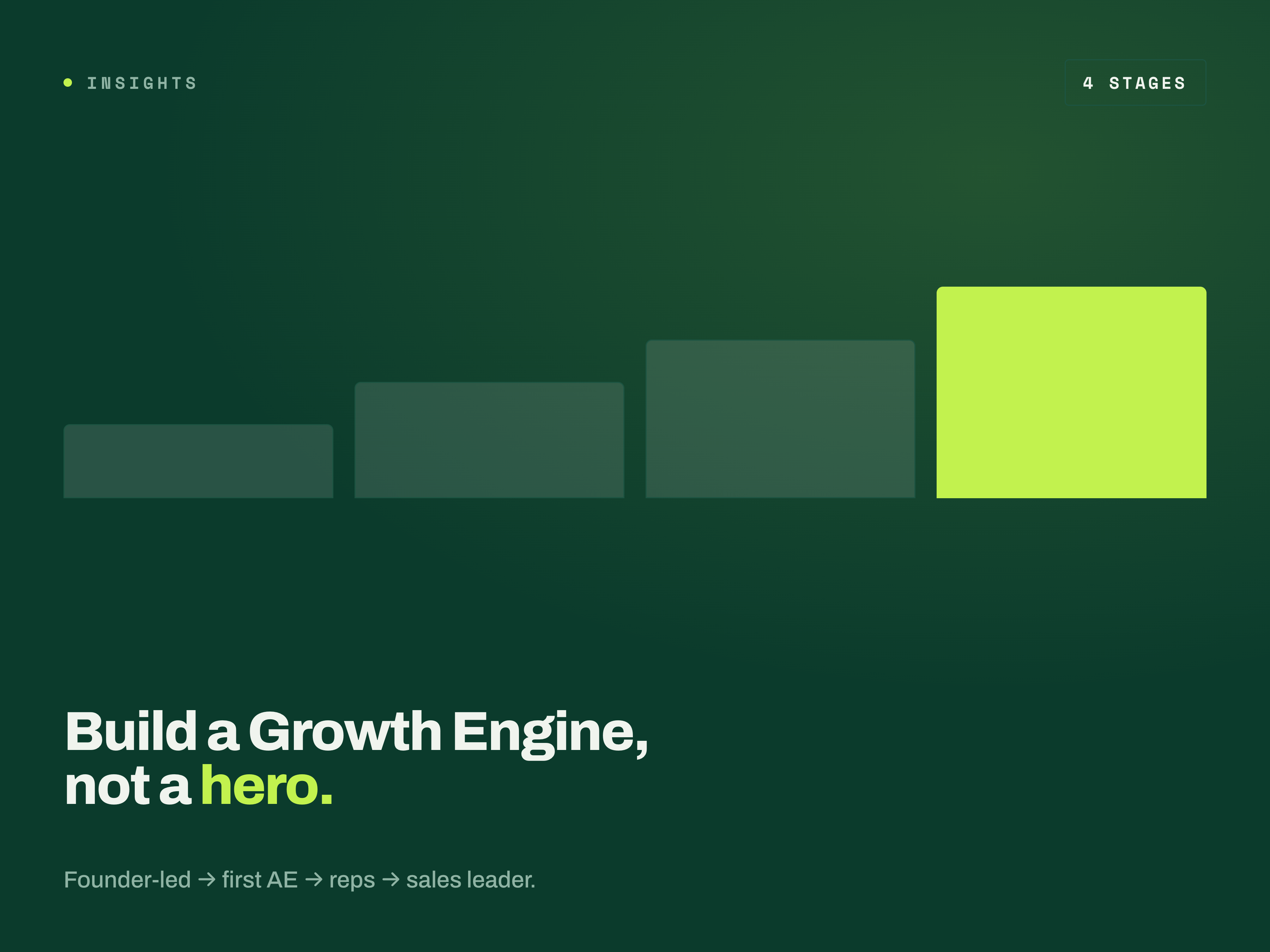
The companies that get through this don't find a better hero. They build a system that doesn't depend on one. A Growth Engine.
It's a different muscle, and it's deliberately staged:
1. Founder-led, on purpose. You close the first 10 to 20 customers yourself. Not because you have to, but because you're mining the pattern: who buys, why, against what objection. This phase produces data, not just revenue.
2. The first AE, to test repeatability. One account executive takes over direct selling. The only question that matters here is whether someone who isn't you can close. Not perfectly. Repeatably.
3. Two or three reps hitting quota. This is the proof. When a second and third rep hit their number on the same motion, you no longer have a founder who sells. You have a motion that works.
4. A sales leader, to codify and scale. Only now do you bring in a Head of Sales or VP, and not to "do sales". To turn the proven motion into a playbook, coach against it, and scale the team on top of it.
Two details that quietly decide whether this works:
Don't put your first reps on a heavy variable comp plan before the motion is proven. You'll be paying for outcomes you haven't yet made repeatable, and the misaligned targets create friction exactly when you need learning, not pressure.
And don't celebrate logos that churn. Selling hard into a leaky bucket is, as one investor put it, a path to nowhere. The engine is acquisition and retention, or it isn't an engine.
The goal was never to hand off selling. It was to make selling repeatable without you. Those are very different projects, and most teams only discover the difference after the expensive hire.
The part founders underrate
Underneath all of this is a mindset shift, and it's the hard one.
Founder-led sales rewards instinct. A Growth Engine rewards evidence. You stop asking "did this deal feel good?" and start asking "do we know our close rate by segment, our CAC payback by channel, our conversion at each stage?" You stop forecasting on optimism and start forecasting on data.
That shift is uncomfortable because instinct got you here. It feels like giving up the thing that worked. You're not. You're making it survivable without you in every meeting. The instinct doesn't disappear, it gets written down, tested, and handed to people who can run it when you're not in the room.
This is the moment most companies get stuck. Going from founder-led sales to a scalable Growth Engine is a different mindset, a different muscle, and almost nobody has spare capacity to build it while also running the business. That's exactly the gap we work in. The Growth Engine is what we build to close it: a systematic inflow that warms the right accounts and makes selling repeatable instead of heroic.
We didn't just learn this from clients. Last year we pointed the same approach at ourselves. For five years Stretch ran almost entirely on referrals and network. It worked, until we admitted it was comfortable, not a system. So we built our own Growth Engine, the same way: positioning, ICP, messaging, funnel, then experiment, then scale. The inflow is now a system that keeps working month after month, and the proof sits on our own P&L, not just in case studies. Falora.ai is how we've productised that same heavy lifting so it runs faster and further.
If your growth still depends on one person's calendar, you don't have a sales problem. You have a Growth Engine you haven't built yet.
The good news: it's buildable. And the day it runs without you in every meeting is the day the company stops being capped by your week.
Share this article


Find out our secret?
Where the ceiling actually sits
The numbers are surprisingly consistent. Founder-led sales tends to max out somewhere around 1 to 2 million in ARR. Some teams stall earlier, some push a little past it, but that's the band where the calendar runs out.
The warning signs are always the same:
→ Growth that was compounding now feels like pushing.
→ Close rates you can't really explain ("some months click, some don't").
→ A pipeline you forecast on gut feel, not on evidence.
→ Your best deals still need you personally in the room.
None of that means your sales are bad. It means your sales are you. And you don't scale.
Why hiring a rep usually doesn't fix it
So founders do the obvious thing. They hire a salesperson. Often a senior one, sometimes a VP with a logo on the CV, and they hand over the calendar with relief.
Then it doesn't work. The new hire doesn't close like the founder did. Six months later everyone quietly agrees it was a bad hire.
It usually wasn't a bad hire. It was a bad handover.
Because here's the thing you actually built in those first years: not a sales team, a sales instinct. You know which leads are real in the first two minutes. You know which objection means "convince me" and which means "no". You know why people buy, because you've watched a hundred of them do it. None of that is written down. So when you hand someone a calendar without the instinct behind it, you're not delegating a system. You're asking them to rebuild your intuition from scratch, alone, on a quota.
That's not a Growth Engine. That's a more expensive bottleneck.
What replaces it: a Growth Engine, not a hero
The companies that get through this don't find a better hero. They build a system that doesn't depend on one. A Growth Engine.
It's a different muscle, and it's deliberately staged:
1. Founder-led, on purpose. You close the first 10 to 20 customers yourself. Not because you have to, but because you're mining the pattern: who buys, why, against what objection. This phase produces data, not just revenue.
2. The first AE, to test repeatability. One account executive takes over direct selling. The only question that matters here is whether someone who isn't you can close. Not perfectly. Repeatably.
3. Two or three reps hitting quota. This is the proof. When a second and third rep hit their number on the same motion, you no longer have a founder who sells. You have a motion that works.
4. A sales leader, to codify and scale. Only now do you bring in a Head of Sales or VP, and not to "do sales". To turn the proven motion into a playbook, coach against it, and scale the team on top of it.
Two details that quietly decide whether this works:
Don't put your first reps on a heavy variable comp plan before the motion is proven. You'll be paying for outcomes you haven't yet made repeatable, and the misaligned targets create friction exactly when you need learning, not pressure.
And don't celebrate logos that churn. Selling hard into a leaky bucket is, as one investor put it, a path to nowhere. The engine is acquisition and retention, or it isn't an engine.
The goal was never to hand off selling. It was to make selling repeatable without you. Those are very different projects, and most teams only discover the difference after the expensive hire.
The part founders underrate
Underneath all of this is a mindset shift, and it's the hard one.
Founder-led sales rewards instinct. A Growth Engine rewards evidence. You stop asking "did this deal feel good?" and start asking "do we know our close rate by segment, our CAC payback by channel, our conversion at each stage?" You stop forecasting on optimism and start forecasting on data.
That shift is uncomfortable because instinct got you here. It feels like giving up the thing that worked. You're not. You're making it survivable without you in every meeting. The instinct doesn't disappear, it gets written down, tested, and handed to people who can run it when you're not in the room.
This is the moment most companies get stuck. Going from founder-led sales to a scalable Growth Engine is a different mindset, a different muscle, and almost nobody has spare capacity to build it while also running the business. That's exactly the gap we work in. The Growth Engine is what we build to close it: a systematic inflow that warms the right accounts and makes selling repeatable instead of heroic.
We didn't just learn this from clients. Last year we pointed the same approach at ourselves. For five years Stretch ran almost entirely on referrals and network. It worked, until we admitted it was comfortable, not a system. So we built our own Growth Engine, the same way: positioning, ICP, messaging, funnel, then experiment, then scale. The inflow is now a system that keeps working month after month, and the proof sits on our own P&L, not just in case studies. Falora.ai is how we've productised that same heavy lifting so it runs faster and further.
If your growth still depends on one person's calendar, you don't have a sales problem. You have a Growth Engine you haven't built yet.
The good news: it's buildable. And the day it runs without you in every meeting is the day the company stops being capped by your week.
Share this article
